(Probably) Granville Penn (1761–1844), London, and from 1834, Stoke Park, Buckinghamshire, and Pennsylvania Castle, Portland;
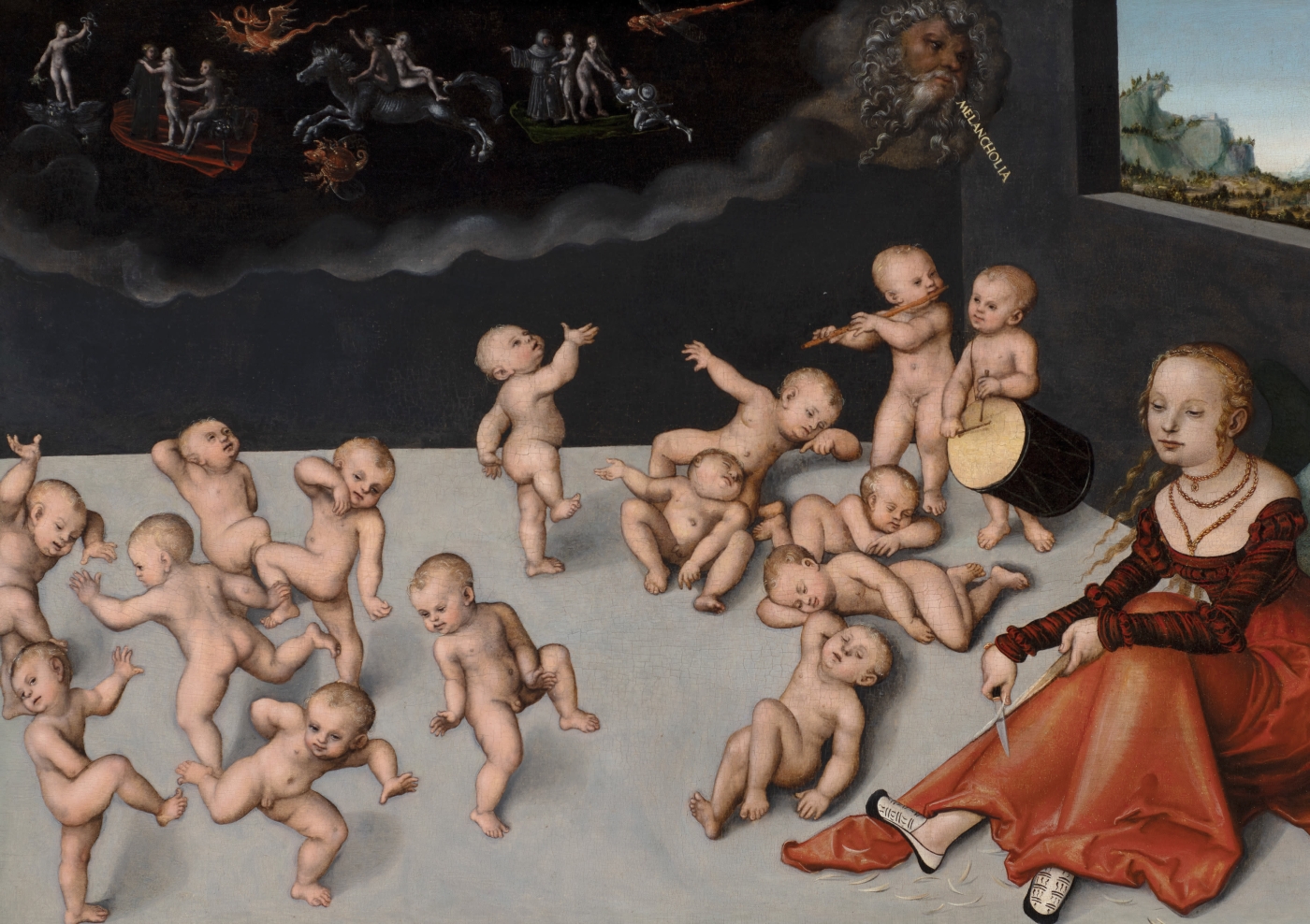
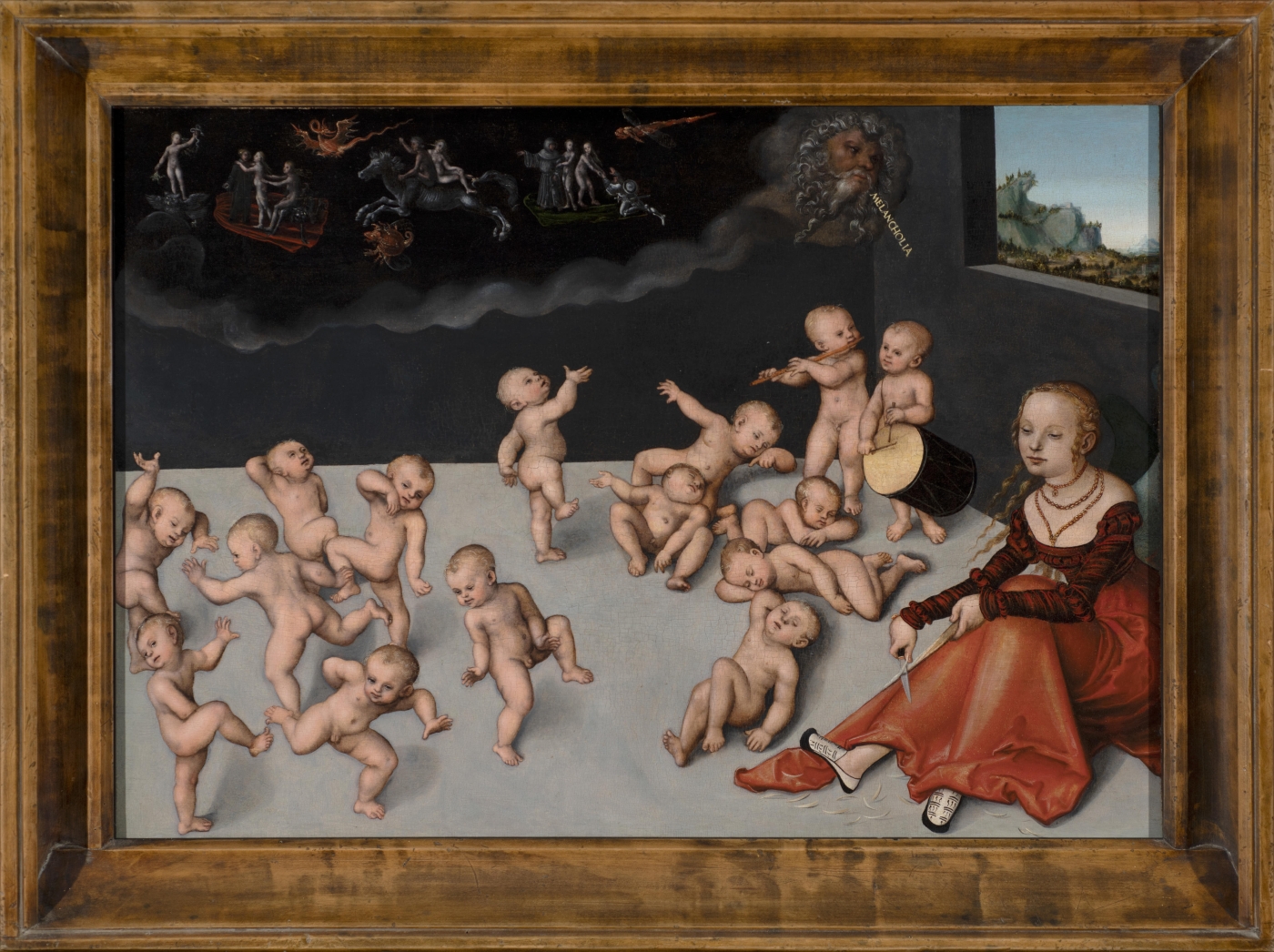
Sale, London, Christie’s, 10 May 1828, lot 119, ‘Melancholy - A Woman with Children dancing and a Vision above’ (unsold);
Sale, London, Christie’s, 3 April 1830, lot 72 (£6 to Wasse);
Private Collection, Southam Delabere, near Cheltenham, by 1906;
With Paul Cassirer, Berlin, 1924;
F. Gutmann, Haarlem;
A. Volz, The Hague, by 1927;
Hans Ferdinand Heye, Düsseldorf, Amsterdam, and by descent until 1989;
Anonymous sale [From a Private Collection], New York, Christie’s, 31 May 1989, lot 103; Anonymous sale, London, Christie’s, 6 July 2006, lot 64 (£512,000);
Anonymous sale [Property of a Gentleman], London, Christie’s, 8 July 2014, lot 11 (£902,500), when acquired by the present owner.
Burlington Fine Arts Club (ed.), Exhibition of Early German Art, exh. cat., London 1906, p. 27, under no. 43;
E. Panofsky and F. Saxl, Dürers ‘Melancholia I’, eine quellen- und typengeschichtliche Untersuchung, Leipzig 1923, pp. 150-1;
M. J. Friedländer and J. Rosenberg, Die Gemälde von Lucas Cranach, Berlin 1932, p. 71, no. 228;
G. F. Hartlaub, ‘Arcana Artis (Spuren alchemistischer Symbolik in der Kunst des 16. Jahrhunderts)’, Zeitschrift für Kunstgeschichte, 6, 1937, pp. 296-7, fig. 3;
G. Bandmann, Melancholie und Musik, Cologne 1960, p. 63, pl. 19;
R. Klibansky, E. Panofsky and F. Saxl, Saturn and Melancholy, studies in the history of natural philosophy, religion and art, London 1964, p. 384;
D. Koepplin, Cranachs Ehebildnis des Johannes Cuspinian von 1502, Basel 1973, p. 225;
Kunstmuseum Basel (ed.), Akten des Kolloquium zur Basler Cranach-Ausstellung 1974, Basel 1977, pp. 24-6;
M. J. Friedländer and J. Rosenberg, The Paintings of Lucas Cranach, London 1978, p. 124, no. 277, illustrated;
C. Heck, ‘Entre humanisme et réforme: la Mélancolie de Lucas Cranach l’Ancien’, La Revue du Louvre, October 1986, p. 260, fig. 6;
C. Zika, ‘The Wild Cavalcade in Lucas Cranach’s Melancholia paintings: witchcraft and sexual disorder in sixteenth-century Germany’, Exorcising our Demons: Magic, Witchcraft and Visual Culture in Early Modern Europe, Leiden and Boston 2003, pp. 369-74, figs. 58-9;
Y. Hersant, ‘Mélancolie rouge’, Mélancolie, genie et folie en Occident, exh. cat., Paris 2005, p. 112;
D. Neave, ‘The Witch in Early 16th-Century German Art’, Woman’s Art Journal, 9, 1988, pp. 7 and 9, note 35;
B. Brinkmann and G. Dette, Cranach, exh. cat., London 2007, p. 316, under no. 97;
D. Hoffmann-Axthelm, ‘Vanitas: Lukas Cranachs Melancholia-Gemälde (1533)’, Music in Art,37, 2012, pp. 192-6, 203, 205 note 7, fig. 5.