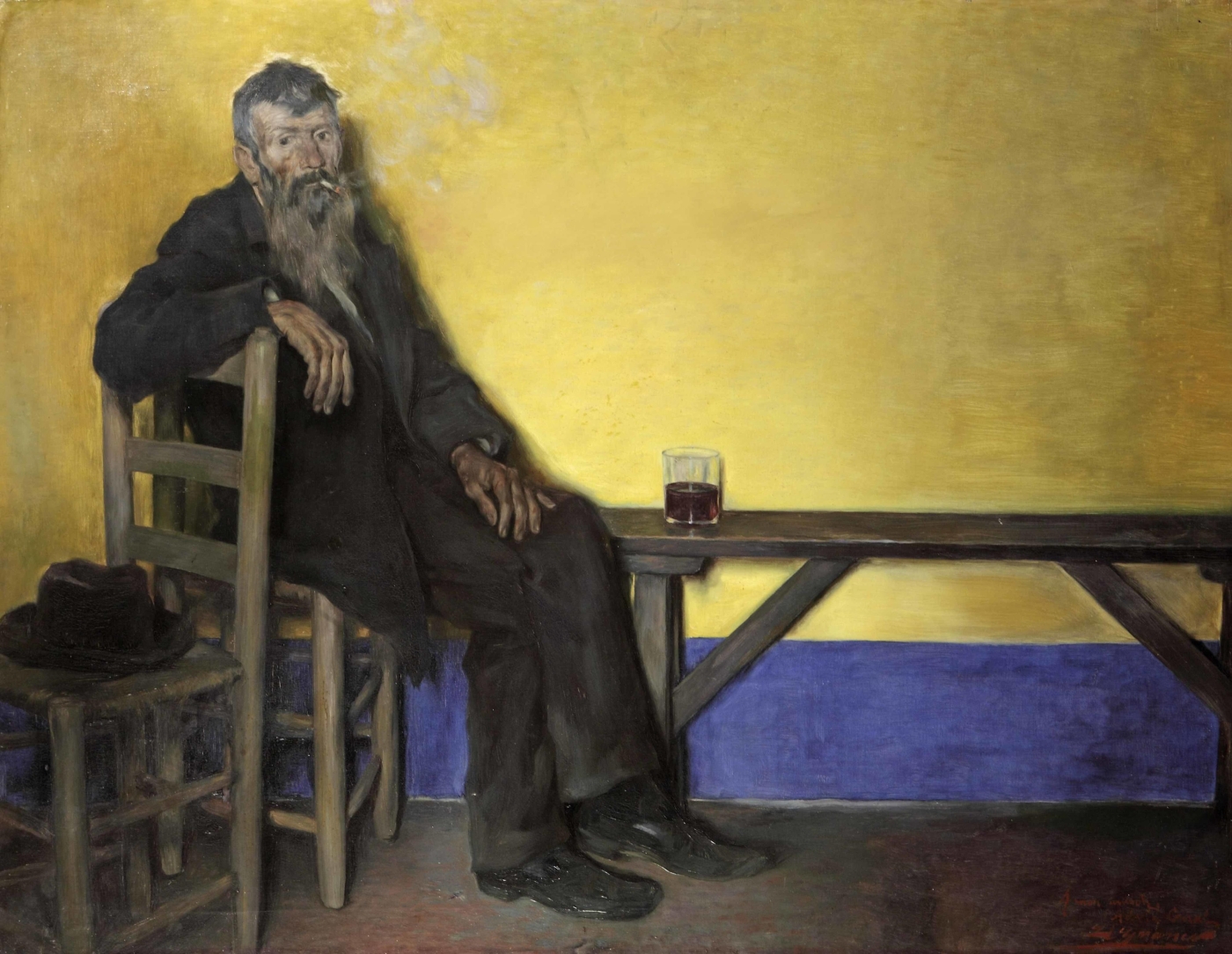
Graner's beginnings in the art world were atypical. In 1878, at the age of fifteen, he travelled to Puerto Rico to work in the retail trade. Due to health issues he had to return to Barcelona and, upon his recovery, went back to Puerto Rico. From there to Havana, where he ended up living poorly until one day he found a family friend, who took care of him and brought him back to Spain in 1873, at the age of twenty. He then enrolled at the Llotja school in Barcelona. During his studies he won all the awards, and in 1886, he obtained a scholarship from the Diputació of Barcelona, the programme included spending three months in Madrid and seven in Rome. The short stay in Madrid was totally decisive in his artistic future, since he studied the masters of the Spanish “Golden Age”, such as Zurbarán, Ribera and, especially, Velázquez.
He excelled in portraits, where the influence of Velázquez is clear, as in our work, Man at the tavern. From the hand of the Parisian dealer Edouard Berrandus, Graner started an American period that any artist would have wanted. In 1910, he inaugured the exhibition "Lluis Graner and Gisart" at the Edouard Berrandus Gallery, on Fifth Avenue in New York. In early April 1911, he presented another exhibition with 76 works at the California Club of San Francisco. This was the largest single-artist show to date, in the city that was devastated by 1906 earthquake. During the San Francisco exhibition, the President of the United States Theodore Roosevelt, praised the work of the Catalan painter; Graner took advantage of those long stays to portray the American high society. In fact, the portrait of Roosevelt Jr. and his wife was displayed at this show. Graner hold two more exhibitions in New York and moved in circles at the exclusive New Port casino, while he continued exhibiting in New Orleans, Santiago de Chile, Rio de Janeiro, Mar de Plata, Montevideo, and Chicago. He, evidently, made strong night landscapes in the vicinity of the Hudson River and New Orleans port. He dived in California and painted the chromatic variety of the seabed. After twenty years in America, he returned to Barcelona in 1928, and died a year later.