It is not fully known which circumstances led Anglada-Camarasa to settle on the island of Majorca, off the eastern coast of Spain, where he resided for two different periods – from 1914 to 1936, and from 1947 to his death in 1959. However, what is certain, is that the island occupied an especially important place in the life and works of the painter. He lived in the town of Port de Pollenca̧ , in the northeast of the island, where he built a house, El Pinaret, and surrounded himself with numerous artist friends from Argentina who he had met in Paris, such as Tito Cittadini (1886-1960) and Roberto Ramaugé (1892-1973). Living and working together there, they proclaimed themselves the ‘Escuela Pollensina’ (School of Pollenca̧ ), without defining guidelines or precise limits.
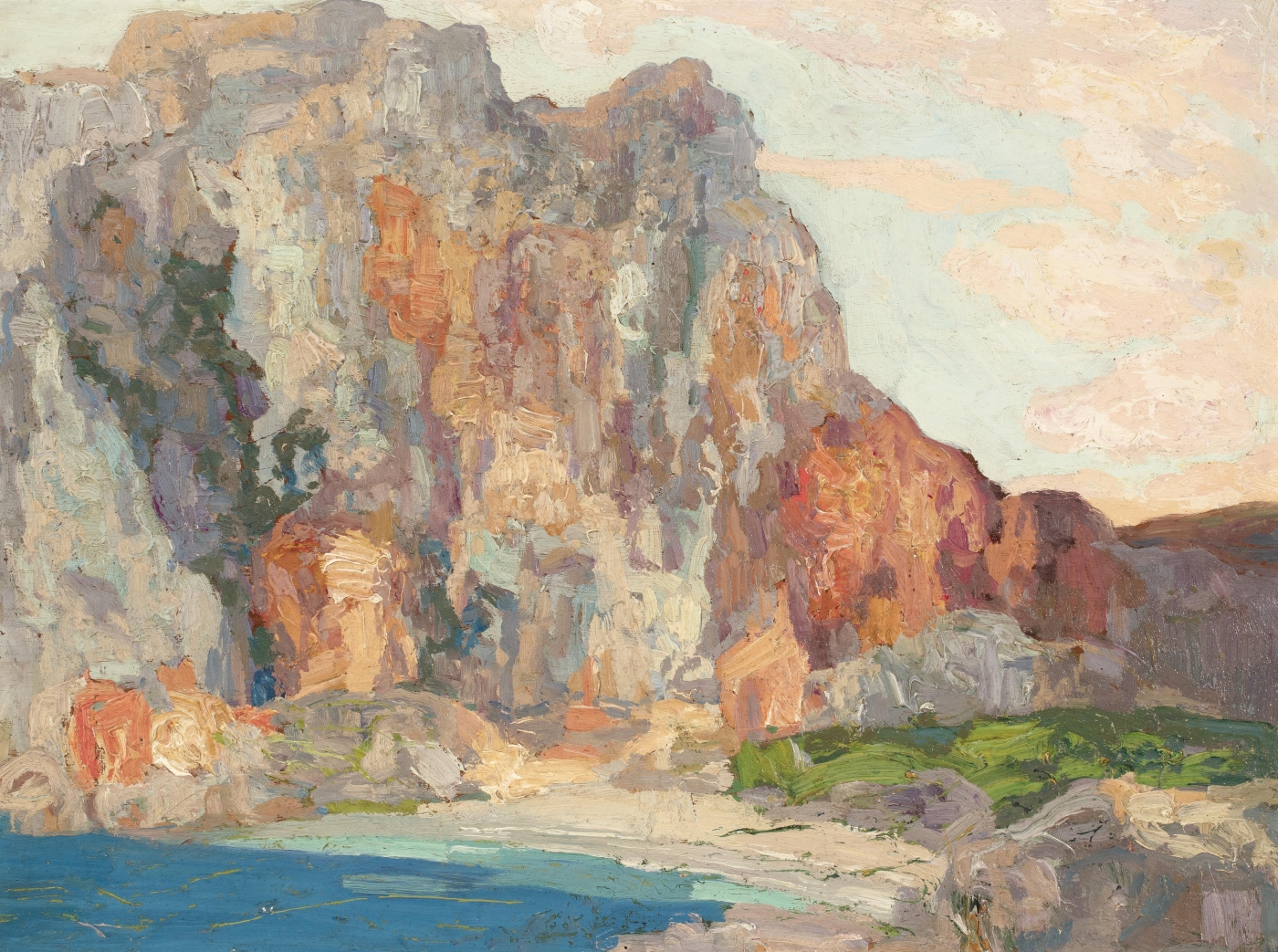
From his arrival in Majorca in 1914, Anglada-Camarasa set aside the representation of female figures and folklore, instead resuming his preferred theme prior to his stay in Paris: landscapes. However, he approached landscapes with a new eye, totally different from his first works. He used a much more daring palette of colours to represent nature, following the developments of the Fauvists in this sense, and elaborated his compositions juxtaposing patches and impastos of colour in the manner of the Impressionists. In contrast to the Impressionists however who worked sur le motif, directly in situ, he took notes which he used later to create works in his studio.
This view of a small Majorcan cove, with the depiction of its sheltering cliffs in the background, is a composition executed by the painter during his first stay on the island. It reflects the new orientation of his work in this period, as much as for the palette used as for the brushstrokes. The forms of the rock, the sand and the sea are done in patches of striking colours, which are far from the real colours of the landscape, but which confer luminosity and great evocative force to the whole composition.