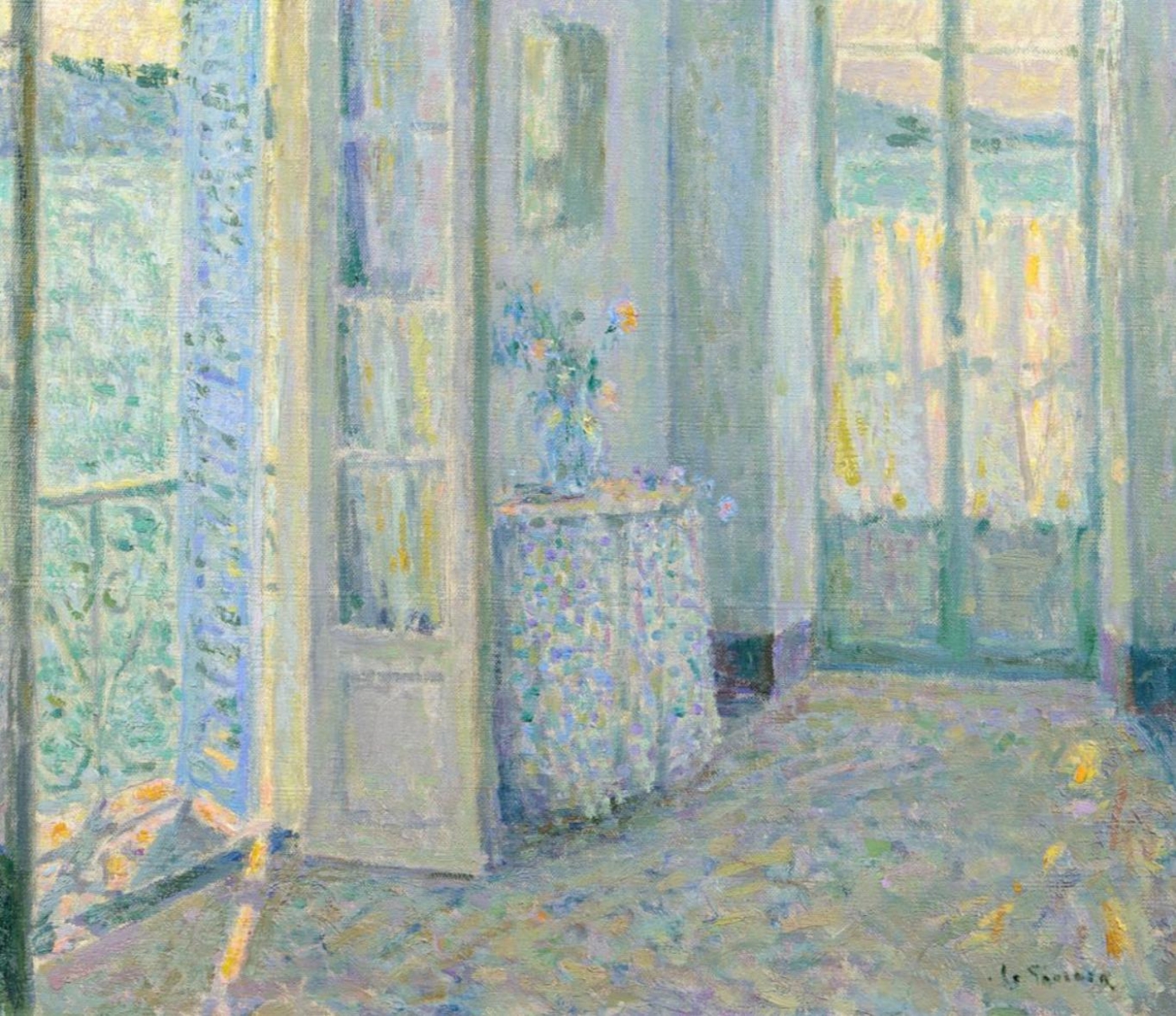
Henri Le Sidaner was born in Mauritius and moved to Paris at the age of 18, becoming a pupil of Cabanel at the Ēcole des Beaux-Arts in 1884. The artist exhibited in Paris for the first time in 1887 at the Salon des Artistes Français. He also exhibited in Paris at the Salon de la Société Nationale des Beaux-Arts and in 1930 was appointed a member of the Institut at the Académie des Beaux-Arts.
In 1900 he visited the tiny village of Gerberoy (Seine-et-Oise) where he later bought the house which became the inspiration for many of his paintings and where he painted many of his beautiful still lifes. He described the town as a “haven of peace” and also described it as being “seeped in history and gentle nostalgia.”
This is probably due to its crucial location both during the battles between the Normans and the English in the 11th Century, and the Hundred Years’ War in the 14th and 15th Century.
Le Sidaner was interested in, and influenced by, the colour theories and pointillism of Neo- Impressionism that the 1900s brought with it. More specifically, the style of Eugene Carrière (which is characterised by indeterminate colours and a taste for a certain misty atmosphere) was admired by Le Sidaner. The focus for both Sidaner and Carrière was on light and how it could be shown on canvas to give objects a three-dimensional effect as well as a sensation of calm and of atmosphere.