Private Collection, London.
Before embarking on our study of the work we are presenting here, it is worth mentioning the recent attention being paid by art history scholars to the mother-of-pearl inlay (enconchado) technique, as although there were reference works published as early as the 1930s, the majority of studies, along with the major discoveries, occurred at a later date, given that of the 250 works known today, only 150 were documented in 1980.
Regardless of intellectual vicissitudes, we may now, with all the known published documentation to hand, speak in no uncertain terms of the enconchado as an artform originating in New Spain. The González family of artists were at the forefront of this marvellous technique from its inception right up to the height of its artistic expression, and it is in this context that this previously unpublished Flight into Egypt came into being, specifically by the hand of Miguel González.
The above ought to serve to contextualize an attribution which, in the absence of specific documentation, and there being no author’s signature (quite common in works by both Juan and Miguel González), relies primarily on a comparative analysis of style and technique.
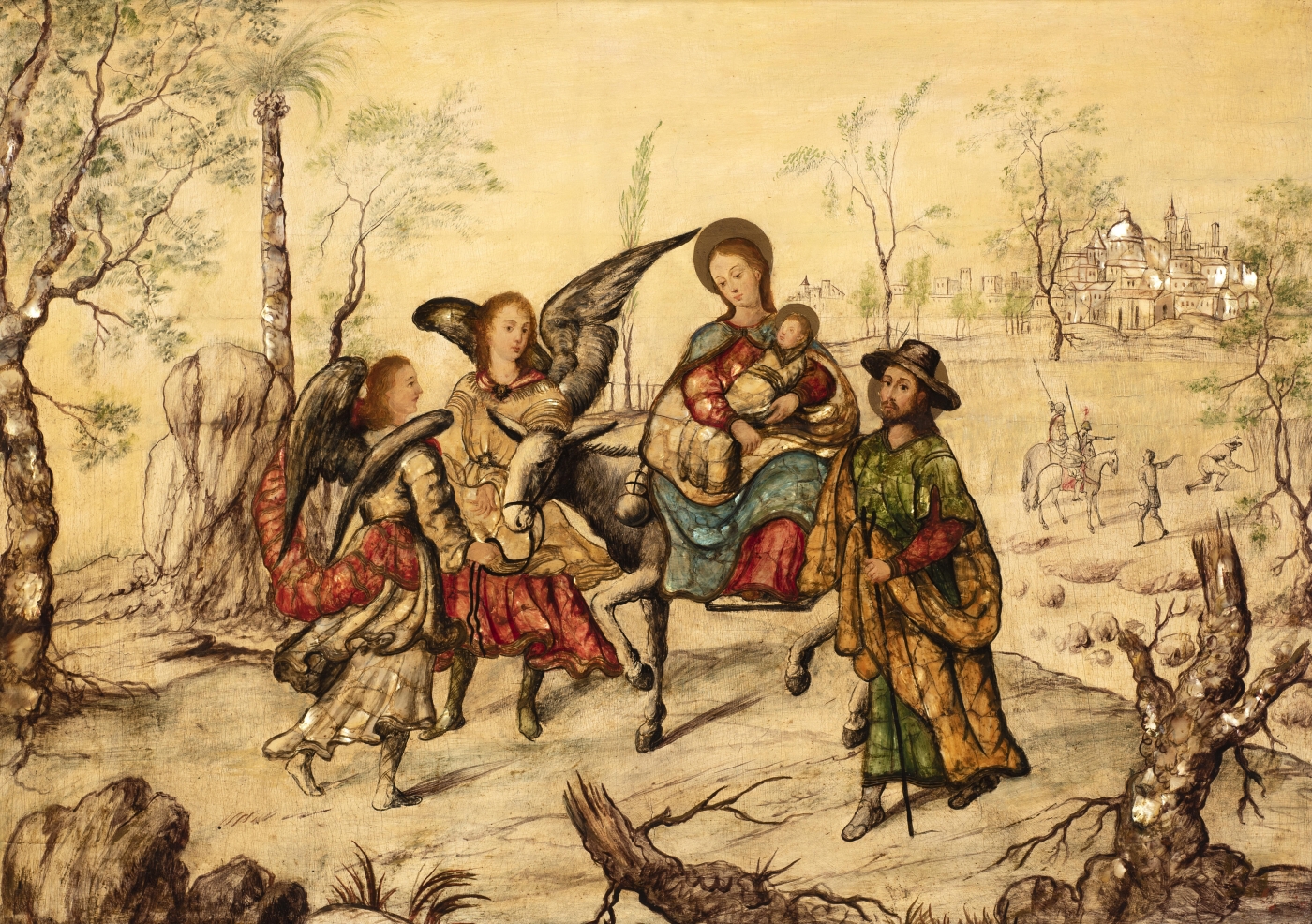
The iconography depicted, which probably drew inspiration from one of the many engravings that were sent to the New World for evangelical purposes, is the Flight into Egypt, an episode taken from Christ’s childhood, the only canonical source for which is to be found in the Gospel according to Matthew:
“When they had gone, an angel of the Lord appeared to Joseph in a dream. ‘Get up,’ he said, ‘take the child and his mother and escape to Egypt. Stay there until I tell you, for Herod is going to search for the child to kill him.’ So he got up, took the child and his mother during the night and left for Egypt”.
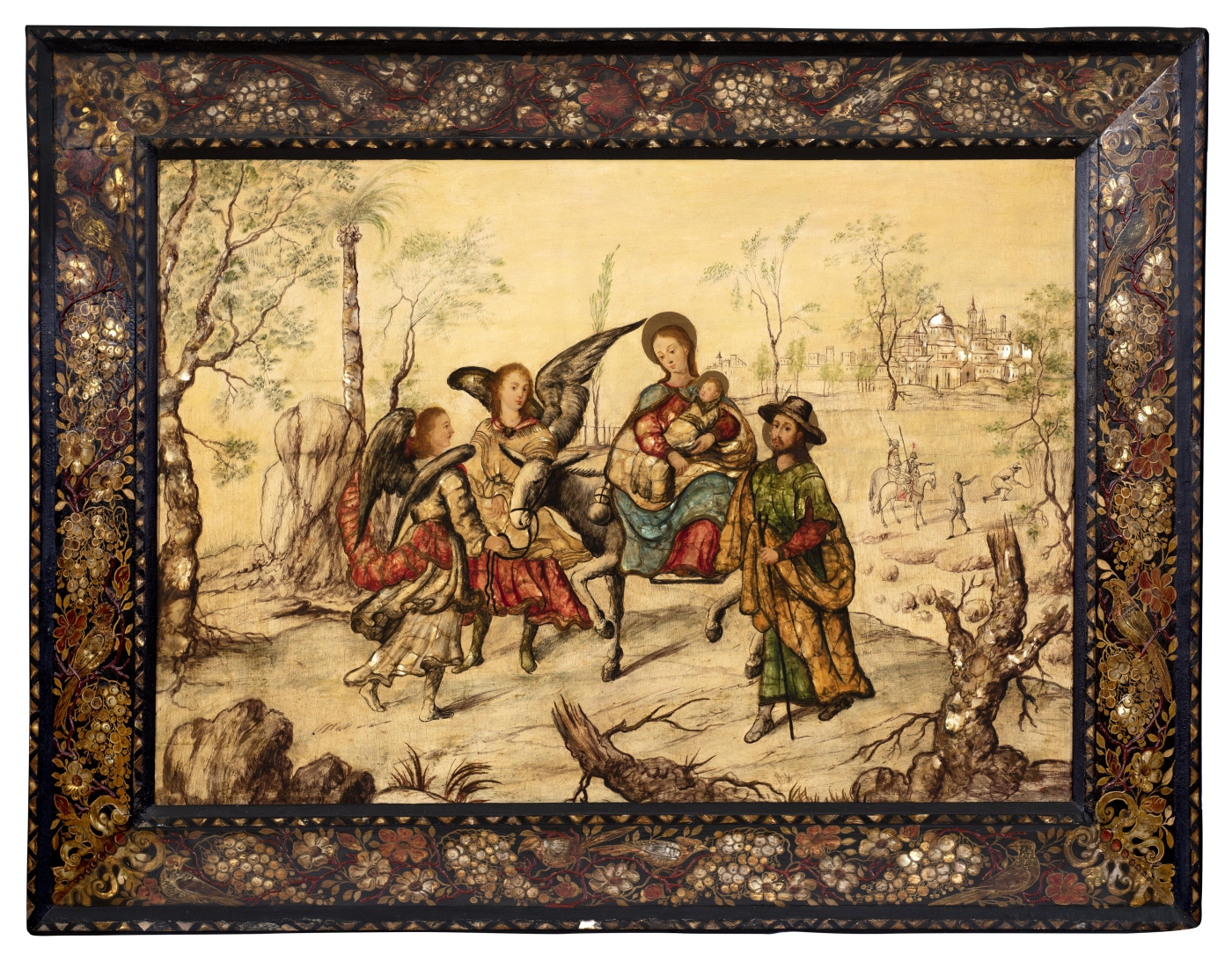
The scene, executed in landscape format, taking place against an open backdrop with a sparsely contrasting palette where tones of sepia predominate producing a watercolour effect, gives us an immediate indication that the Mexican painter may well have been its author. In the first place, and occupying the middle of the image, which features the greatest density of mother-of-pearl, generating an explosion of iridescent colour, we find the protagonists of the story. The Virgin Mary, wearing a blue cloak, pink robe and boasting a golden aureole, is carrying the new-born Infant Jesus in her arms, swathed in a white cloth, while she travels sat on the back of a donkey which two opulently-dressed angels are pulling by its halter. To her left, St. Joseph is seen walking with the aid of a stick, dressed in a red shirt, green robe and yellow cloak and hat. The central composition, which bears witness to Miguel González’s careful and painstaking drawing, evident in the delicate faces of the Virgin and St. Joseph, is made up of dazzling little fragments of mother-of-pearl, arranged in mosaic fashion to simulate their clothing, covered by a thin and transparent pictorial layer that does nothing to diminish their brilliant sheen.
In the background, and helping to lend the panel a certain depth, we observe a group of four figures, fainter both in line and colour, made up of two Roman soldiers and two peasants. Behind them, the city of Jerusalem catches the eye due to its lavish architecture, built up on fine sketching combined with painstaking inlay work.
In conclusion, as one final compositional element and a González family hallmark, it is worth noting the trees, with their stumpy trunks, arranged in the foreground and embellished, beyond the drawing, using the aforementioned inlay technique.
The other component that serves to confirm the attribution, beyond all of the comparative compositional elements, may be observed in the work’s frame, as the González family artists paid particular attention to the presentation of their frames, which had a characteristic style, accompanying the work almost as part of it, with painting and frame combining to form one single entity in perfect harmony. Although the technique employed here is the same as on the painting, the aesthetic aim of this decorative element was different, being more akin to a Japanese style of lacquerware known as namban. The frame we have before us here, which is particularly rich in ornamentation, is conceived of as a border around the painting, populated with flowers, leaves, birds, bunches of grapes and other decorative motifs, with a certain level of relief, whose fattura is much the same as the frames seen in the series of the Life of the Virgin attributed to either Miguel or Juan González, eight works from which are preserved in Madrid’s Museo de América. It is also known that three more works belonging to this series exist, though their whereabouts are currently unknown, with one such possibly being the Adoration of the Magi from a Catalan private collection, while the Flight into Egypt we have before us here could well be another. The similar execution of the ornamental motifs present on the corners of the frame from this series and those visible in the works at the Museo Nacional del Virreinato in Tepotzotlán should serve to reinforce our attribution.