Presumably Cavaliere Giacomo Girardo Mastrogiudici, Sorrento, by 1742;
Probably María Cristina de Borbón-Dos Sicilias (1779 – 1894), Princess of Naples and Sicily, Naples;
Probably by family inheritance to Dom Sebastian Gabriel of Bourbon and Braganza (1811 – 1875), Infante of Portugal and Spain, Madrid, in the 19th century;
By family inheritance to Manfredo Luis de Borbón (1914 – 1979), 1st Duke of Hernani, 3rd Duke of Ansola, Madrid, by 1963;
With Galería Velázquez, Madrid, 1972;
With Manuel González, Madrid, 1970 – 1979 (by whom advertised in Apollo, May 1970);
Anonymous sale, London, Christie’s, 9 December 1988, lot 16;
Private collection, Madrid, from whom acquired by the present owner.
Pau, France, L’Ancien Asile, Tableaux appurtenant aux héritiers de Feu Mgr. L’Infant Don Sébastien de Bourbon et Bragance, September 1876;
Naples, Gallerie Nazionali di Capodimonte, Civiltá del ‘700 a Napoli 1734–1799, December 1979 – October 1980, no. 69;
Detroit, The Detroit Institute of Arts, 11 August - 1 November 1981;
Chicago, The Art Institute of Chicago, 16 January – 8 March 1982, The Golden Age of Naples. Art and Civilization Under the Bourbons, 1734–1805, no. 14.
Presumably B. de Dominici, Vite dei Pittori, Scultori e Architetti Napoletani, Naples 1742, vol. III, p. 566;
Catalogue of the collection of Princesa Maria Cristina di Borbone, Madrid 1902 (as measuring 207 x 154 cm.);
J. Urrea-Fernández, La Pintura Italiana del Siglo XVIII en España, 1977, pp. 324 – 25, reproduced pl. CI(2);
Gallerie Nazionali di Capodimonte, Civiltá del ‘700 a Napoli 1734-1799, exh. cat., Florence 1979, vol. I, p. 168, cat. no. 69, reproduced p. 169;
S. F. Rossen, S.L. Caroselli (eds.), The Golden Age of Naples. Art and Civilization Under the Bourbons, 1734-1805, exh. cat., Detroit 1981, p. 91, cat. no. 14, reproduced p. 92;
M. Stoughton, ‘The golden age of Naples: art and civilization under the Bourbons 1734 – 1805’, in Art Journal, vol. 42, no. 1, Spring 1982, p. 55;
N. Spinosa, Pittura Napoletana del Settecento, Naples 1986, p. 173, cat. no. 344, reproduced p. 159, colour pl. 75.
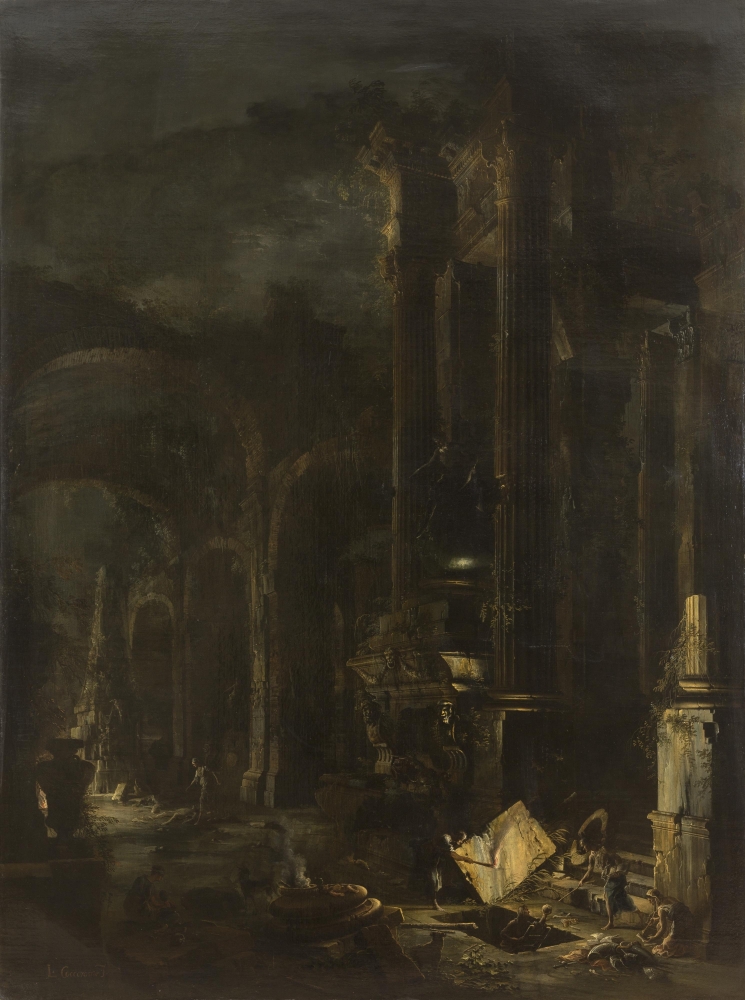
Coccorante’s monumental canvas depicting towering classical ruins is lit only by the flames of torches and silvery moonlight. The torches are carried by witches in the throes of exhuming a skeleton from a tomb. The location of this sorcery is likely a capriccio (a view representing a fantasy or a mixture of real and imaginary features); a subject in which Coccorate specialised.
Leonardo Coccorante was a leading landscape painter in Naples in the early 18th century. He worked in the circle of the great Luca Giordano (1634 – 1705) and came to demonstrate all the grandeur and drama of late Baroque painting that was exemplified in Giordano’s influential oeuvre. Coccorante is known to have learnt his trade from a Sicilian painter of ruins, Angelo Maria Costa (1670 – 1721), who had found himself in a Neapolitan prison awaiting execution for burglary, when he and Coccorante, a jailer’s assistant, first met. He later benefitted from the tutelage of Jan Frans van Bloemen (1662 – 1749), known as Orrizonte, a Flemish landscape painter active mainly in Rome but known to have visited Naples. Unlike much of the landscape painting executed in the early 18th century, such as those views by Antonio Joli, Carlo Bonavia, Pietro Fabris and those by foreigners in Naples such as Thomas Jones and Claude Joseph Vernet, Coccorante moved away from the realism of their depictions of landscape and instead imbued his scenes with a Romanticism more reminiscent of the influence of Salvator Rosa (1615 – 1673). Rosa’s influence is especially notable in Coccorante’s often eerie and atmospheric lighting, and in his sinister figures that are frequently caught in acts of robbery or assault, or in the aftermath of mayhem and murder; all of which are exemplified in the present canvas.
This canvas, described by Nicola Spinosa as one of Coccorante’s most remarkable scenes of ruins, has exceptional provenance. It was first recorded in 1742 by the Neapolitan art historian Bernardo de Dominici when he saw this canvas in the private collection of Cavaliere Giacomo Girardo Mastrogiudici in Sorrento. The painting he mentions ‘che veramente puo dirsi opera mirabile’ has been identified as the present work, in accordance with his description of the subject matter and the matching dimensions. De Dominici writes that the figures are by Giovanni Marziale. Nicola Spinosa dates this canvas to 1731, executed shortly before Marziale’s death later that year, however it has also been suggested that the strong influence of Salvator Rosa would suggest that it is a relatively early work by Coccorante and may have been executed considerably earlier. Urrea-Fernández (see Literature) was the first to note the probability that this painting is that which later appeared in the collection of Princess María Cristina di Borbone, and thereafter passed down through various branches of the Bourbon family until it appeared on the art market in Madrid in the 1970s.