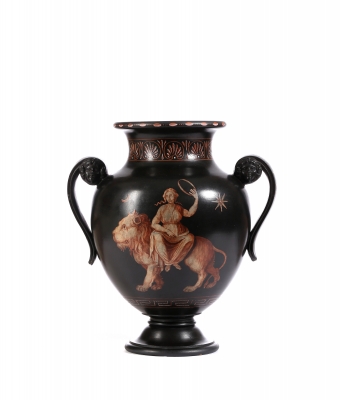
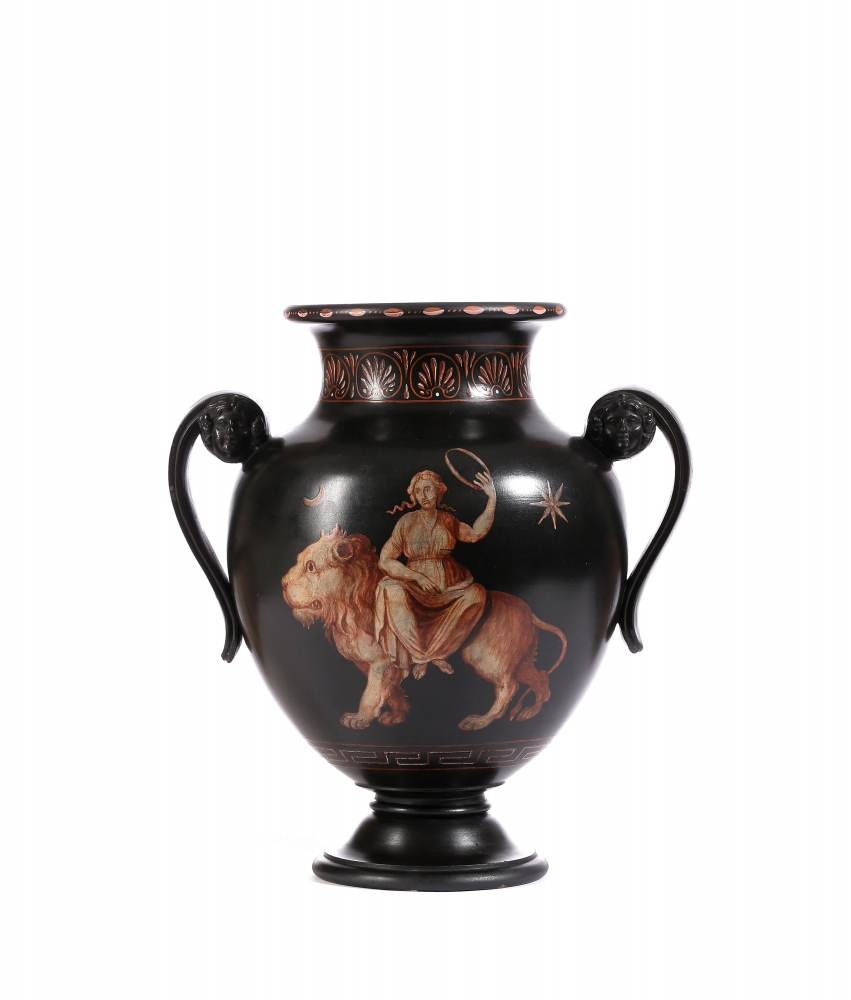
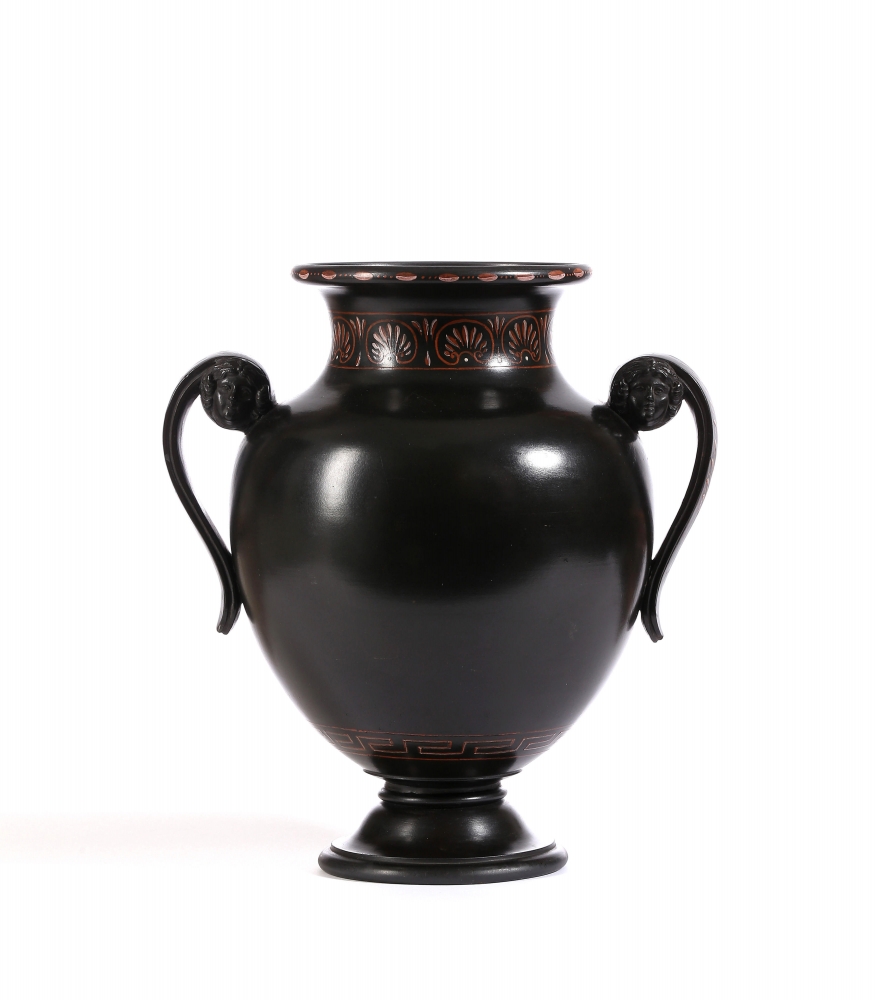
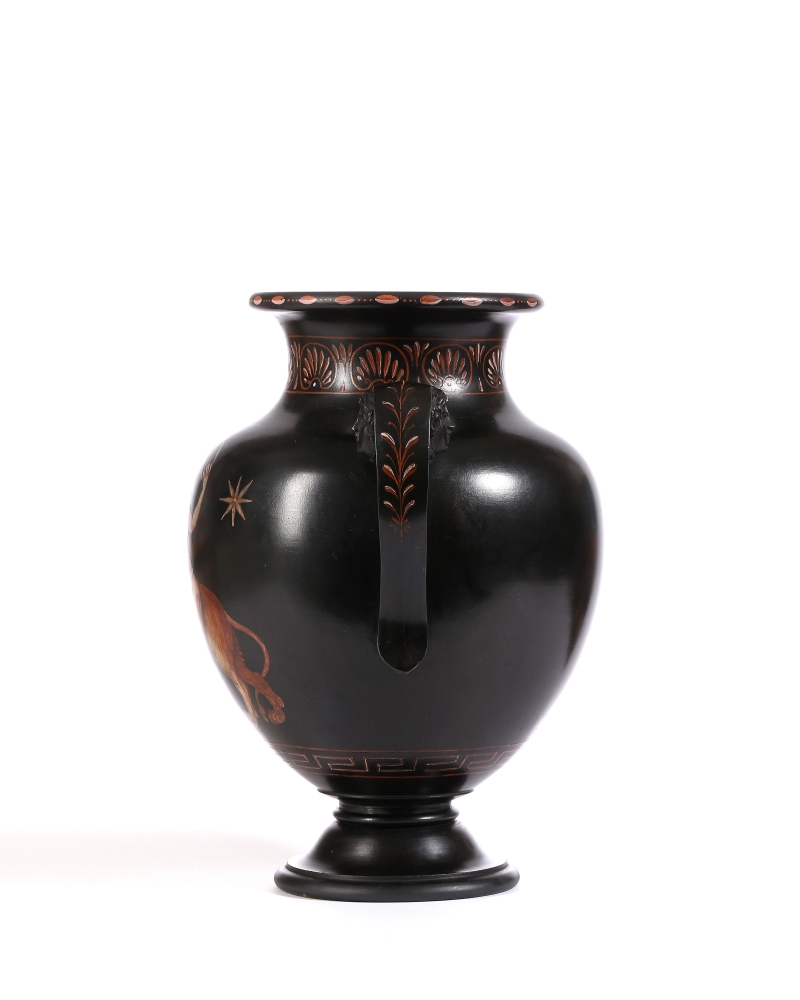
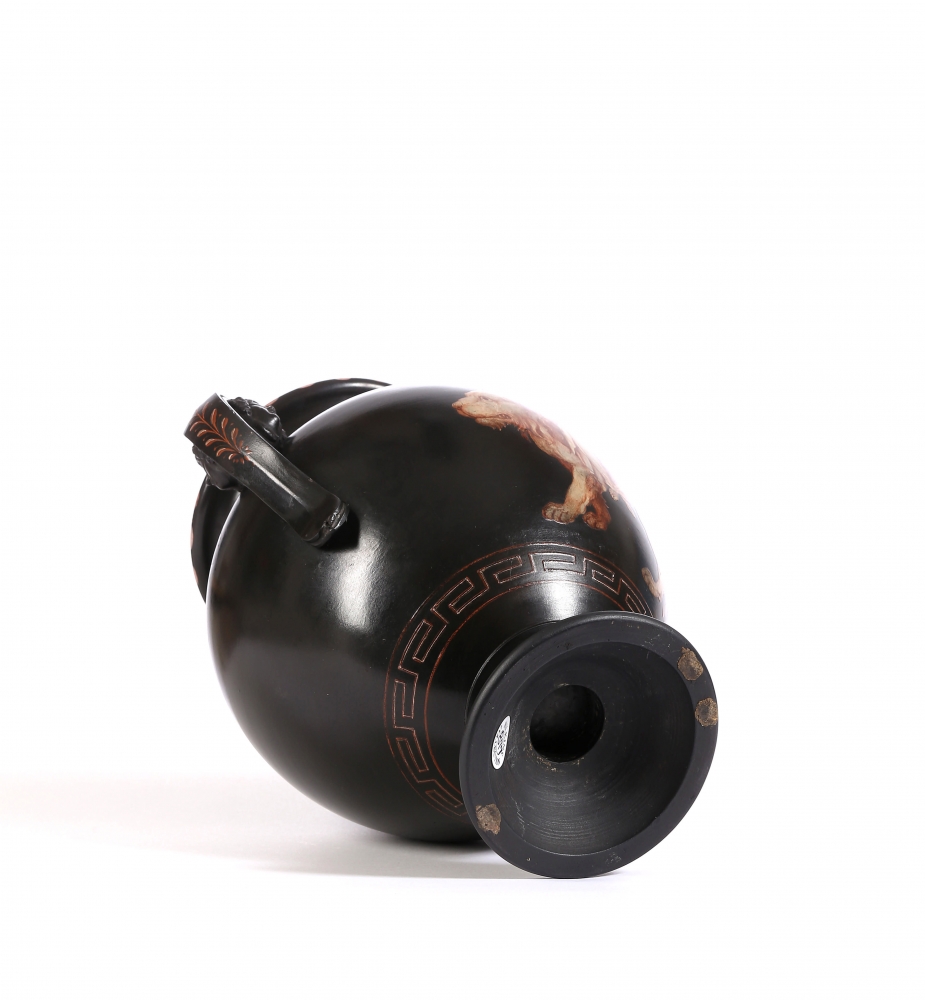
Like the other Wedgwood vase in the current exhibition, this vase is one of a group of so-called basalt vases, more properly known as black stonewares, which Wedgwood, with his shrewd sense of marketing, named after the black hardstone used in antiquity whose appeal lay partly in its resemblance to bronze. These were produced by Wedgwood and Bentley in their Etruria factory from 1768. Unlike its counterpart in the present exhibition, which is directly modelled on the plates published in D’Hancarville’s catalogue of Sir William Hamilton’s collection of vases, the present vase is not copied from - but loosely inspired by - this famous publication. The form of the vase is based on Greek prototypes, but here the decoration showing the figure of Rhea or Cybele riding on a lion, which does occasionally appear in the iconography of Greek red-figure vases, is far more “baroque” and three dimensional in its conception, and in fact derives from a plate in Bernard de Montfaucon’s L'antiquité expliquée, et représentée en figures (1655-1741), a standard source book for classical motifs from the mid seventeenth century onwards. The term “encaustic” was adopted by Wedgwood to suggest a link between the decoration of his basalt vases and Roman wall paintings, such as those which had recently been discovered in the 1730s and 1740s at Pompeii and Herculaneum.
Pinch to zoom