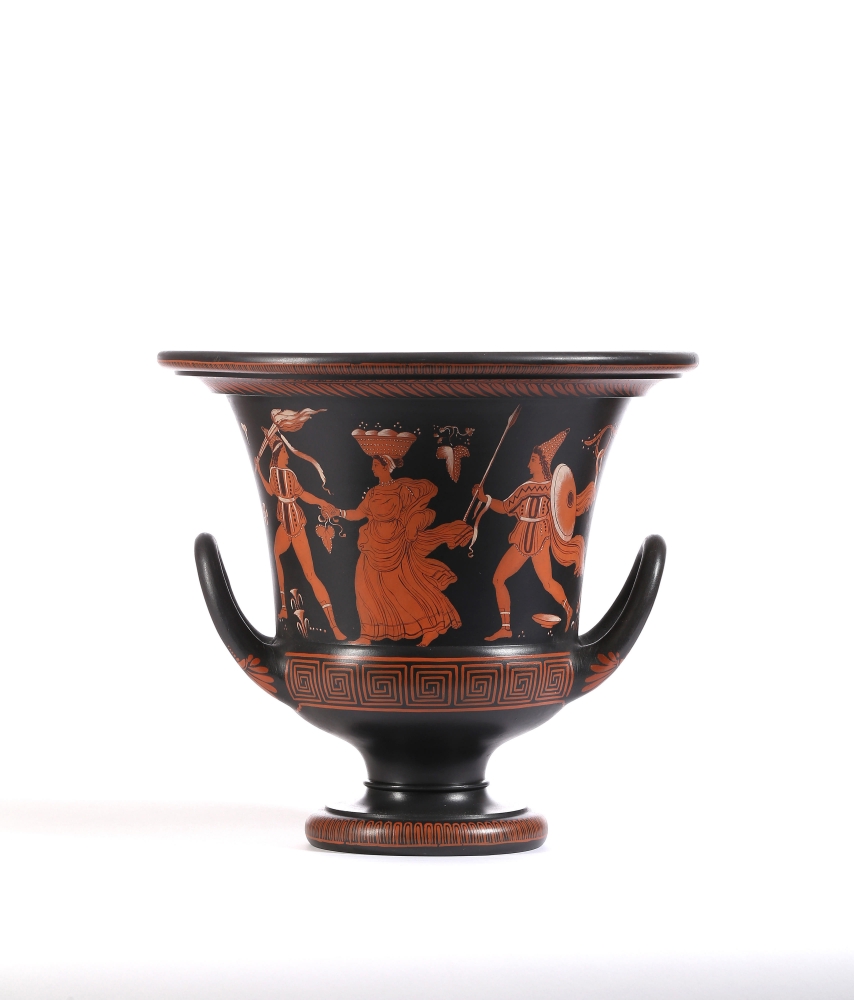
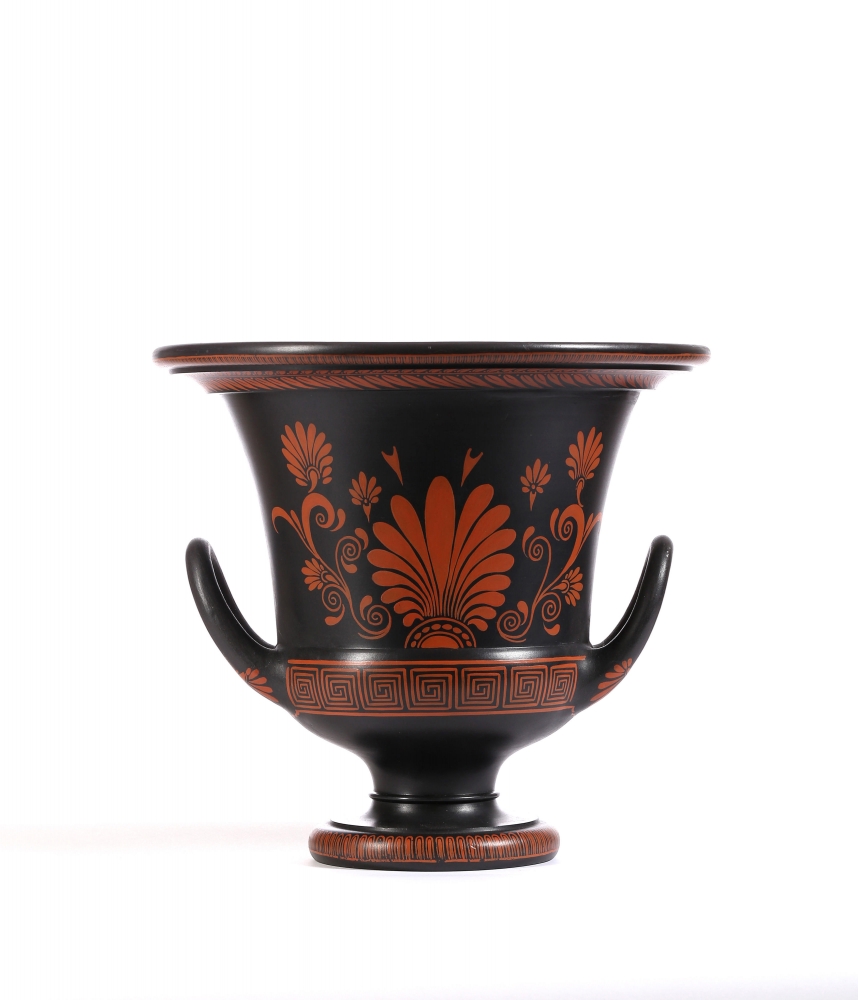
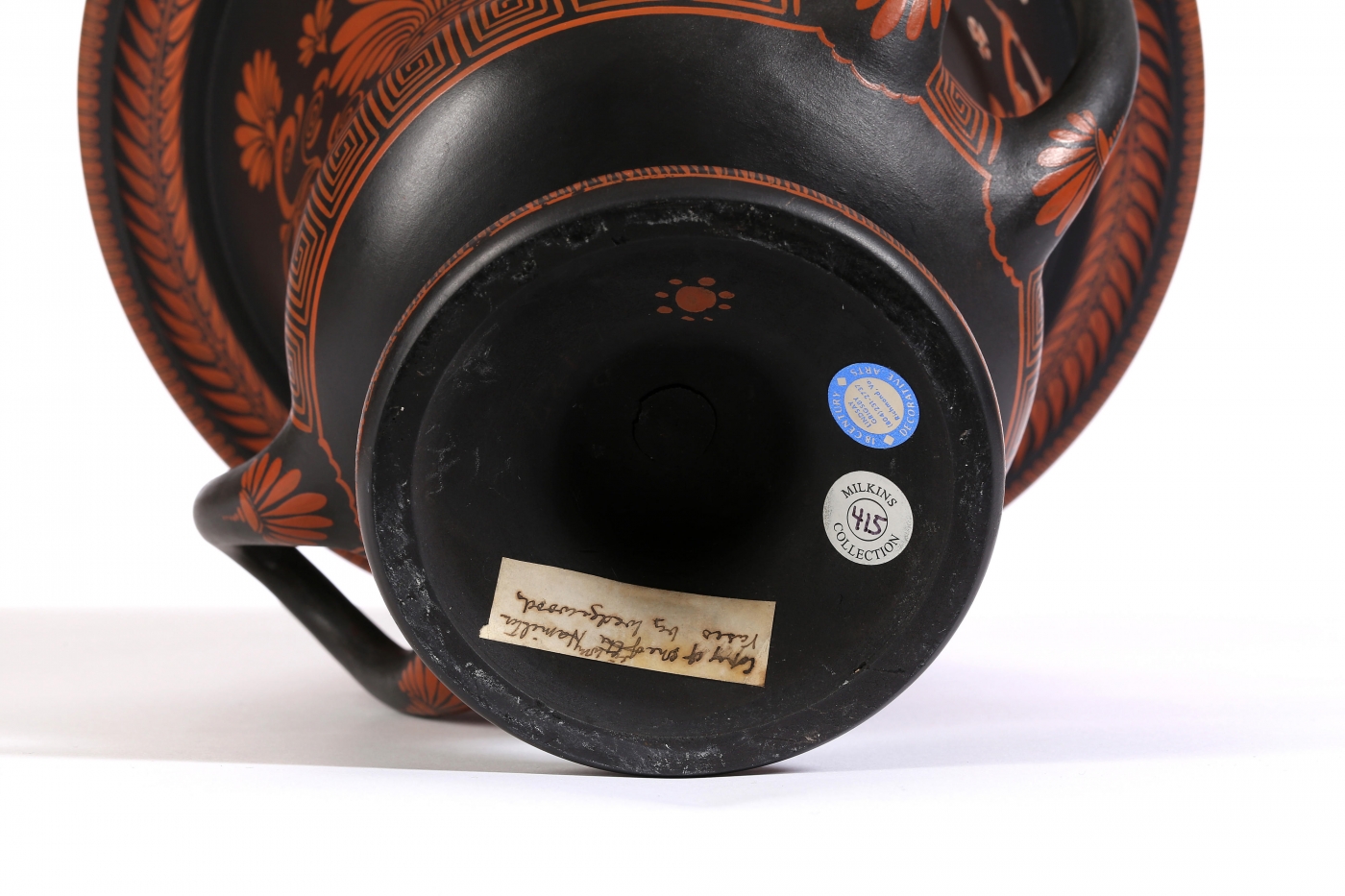
This vase is one of a group of so-called basalt vases - stonewares named after the black hardstone used in antiquity - which were produced by Wedgwood and Bentley in their Etruria factory during the 1770s, whose form and decoration were inspired by the seminal publication, under the auspices of the Society of Dilettanti, of the famous collection of Greek, Etruscan and Roman vases which had been formed by Sir William Hamilton, the British Envoy in Naples. Many of these were sold to the British Museum, forming one of the core elements in the museum's collections of Greek and Roman antiquities. This publication - a landmark In European neoclassicism - was commemorated by Sir Joshua Reynolds in one of the pair of group portraits of members of the Society of Dilettanti, which are now in Brooks' Club, London. There Sir William sits in the centre of the group, one of the volumes open on the table together with one of his vases, and is toasted by his fellow members. The publication not only inspired Wedgwood's basalt wares, but also the decoration of a series of so-called ‘Etruscan rooms’, the most famous of which, designed by Robert Adam in the 1770s, is the Etruscan Dressing Room at Osterley Park. The word ‘Etruscan’ was a misnomer, because most of Hamilton's vases were in fact Greek, but, because they were excavated In Southern Italy, which had been a Greek colony, they were initially thought to have been made by the Etruscans. It is clear that, by the early 1770s, Wedgwood was aware of this fact, because in his Ornamental Catalogue of 1773, he wrote: ‘It is evident that the finer Sort of Etruscan Vases, found in Magna Graecia, are truly Greek workmanship, and ornamented chiefly with Grecian Subjects, drawn from the purest Fountain of the Arts’.
Wedgwood was given a copy of Pierre-François Hugues d'Hancarville’s sumptuous 4-volume catalogue, Collection Of Etruscan, Greek And Roman Antiquities From The Cabinet Of The Honble. Wm. Hamilton (also included in the present exhibition), on September 20 1769 by his admirer and patron Sir Watkin Williams Wynn, himself a prominent member of the Society of Dilettanti. Shortly afterwards, Wedgwood, sensing a business opportunity, wrote to his partner Thomas Bentley suggesting that he should ‘give Ld. Cathcart a hint that we are preparing to paint the Etruscan Vases after Mr Hamilton’s book?’. In January 1768, Wedgwood again wrote to Bentley, who was an accomplished classical scholar, asking for his help in researching the techniques that had been used in antiquity: ‘You will easily imagine what may be of any use to me in the Antiquitys if you find time to dip into them. The colours of the Earthern (sic) Vases, the paintings, the substances used by the Ancient Potters, with their methods, of working, burning, &c…Who knows what you may hit upon, or what we may strike out betwixt us you may depend on an ample share of the profits arising from any such discoverys’.
In the event, the decoration of the Greek wares proved much more complicated than Wedgwood had realised, though he was able to achieve a similar effect by using a black body - which he called basalt - and by painting the surface with slips and enamels which could be applied thinly and accurately with a matt rather than glossy surface.
Wedgwood knew that his technique of decoration differed from that of the ancient Greek potters, but for advertising purposes claimed in his ornamental catalogues: ‘The Art of Painting Vases in the Manner of the Etruscans has been lost for Ages; …The Proprietors of this Manufactory have been so happy as to rediscover and revive this long lost Art’. Wedgwood found these wares difficult to produce, writing to Bentley in 1768: ‘I have been turning two or three sorts of faithfull copys from Etruscan Vases & am quite surpris’d both at the beauty of their forms, & the difficulty of making them, especially in pairs’.
After beginning production of his so-called Etruscan vases in 1768, Wedgwood named his new factory ‘Etruria’. The wares were expensive; writing in December 3 1772, he lamented that ‘The Grecian vases we have are sadly too dear… Whenever we tell the price … I am sure of a full stare … & either some note of admiration or absolute silence’.
For a Wedgwood and Bentley marked ‘encaustic-decorated’ vase and cover with the same Bacchanalian scene, see the Spak Collection, no. 355, at the Law Library Special Collections, Florida International University.